


The sharpening technology of tungsten carbide saw teeth is crucial, as improper sharpening can affect the performance of this advanced cutting tool. The selection of grinding wheels with appropriate abrasives, binders, and shapes has a significant impact on the sharpening quality of tungsten carbide saw teeth.
There are two situations in which carbide saw blades need to be dressed: first, before new saw blades leave the factory; second, after saw blades have been used for a period of time.
How To Sharpen Carbide Saw Blade Before leaving the factory
1 Selection of grinding wheels for sharpening carbide saw blade
The sharpness of carbide saw blade teeth directly determines the cutting force, processing quality, and durability of the teeth.
During sharpening carbide saw blade , we typically select brown fused alumina abrasives with a grain size ranging from 46 to 60, a hardness of ZY1, and a ceramic binder.
It is recommended to use a single – bevel shaped grinding wheel with an outer diameter controlled between 200 and 250 mm and a thickness of 12 mm. For straight – back band saw teeth with a pitch greater than 30 mm, setting the grinding wheel thickness to 1/3 of the pitch will help achieve an ideal gullet shape.
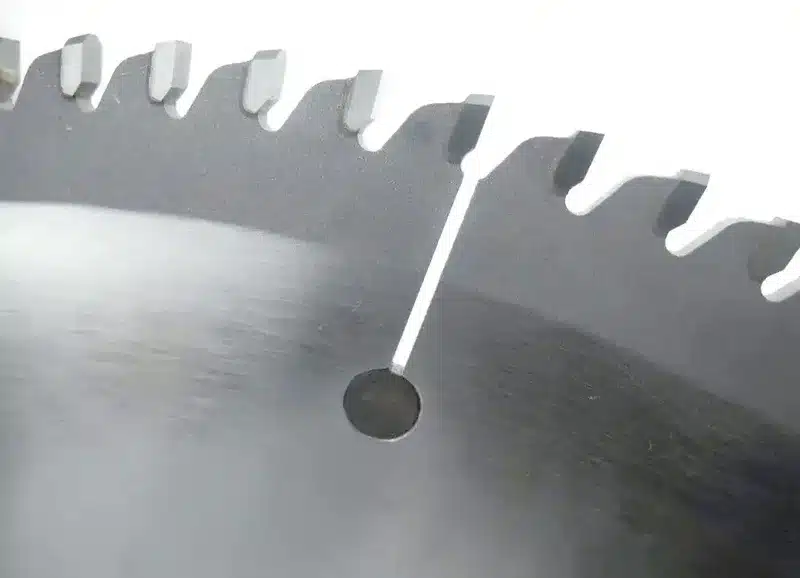
For sharpening tungsten carbide circular saw teeth, you can choose either green silicon carbide grinding wheels or diamond grinding wheels. For silicon carbide grinding wheels, a vitrified bond should be selected, and the appropriate grain size should be chosen according to different grinding stages. During rough grinding, a grain size of 36 – 46 is recommended, while for fine grinding, a grain size of 80 – 100 is preferred. The hardness of the grinding wheel should be controlled within the range of R3 – ZR1. Resin bonded diamond grinding wheels are the first choice, and vitrified bonded diamond grinding wheels are becoming increasingly popular. For JIG grinding, electroplated diamond grinding heads are usually selected.
2 Precautions during sharpening carbide saw blade
Before installing a grinding wheel, the shape, size, and correct installation of the wheel are crucial to ensuring sharpening safety and effectiveness. It is essential to check for cracks to guarantee safe use. The grinding wheel should be mounted on the saw shaft with a moderate tightness, ensuring that its center aligns with the central plane of the saw in the thickness direction.
Below is a picture of commonly used diamond grinding wheels for woodworking tools

During the tungsten carbide sharpening process, you need to pay attention to the shape and size of the grinding wheel. The diameter D of the bowl-shaped grinding wheel is 150mm, the disc-shaped grinding wheel is also D=150mm, and the diameter of the flat grinding wheel can reach 200mm. In addition, the resin diamond grinding wheel (inner chain) has excellent sharpening efficiency and quality, but the price is relatively high.

When sharpening, the tooth groove should be trimmed into a regular circle first, which helps prevent the feed claw from getting stuck and avoids the grinding wheel from sharpening the front and back parts of the saw teeth too much. After sharpening, the burrs left on the saw teeth need to be removed, because the micro cracks contained in these burrs may extend into the inside of the saw body. At this time, you can use a carbide grinding wheel to remove the burrs, and pay attention to controlling the diameter and speed of the grinding wheel.
2 Automated sharpening carbide saw blade equipment and methods
The automatic sharpening machine is more powerful, can handle a variety of tooth shapes and is easy to operate, which improves efficiency and precision. It can not only sharpen narrow band saw blades and gang saw blades, but also sharpen straight and vertical saw teeth, oblique and horizontal saw teeth, and can easily handle different tooth shapes such as straight back, curved back and truncated back.
In this way, carbide circular saw blades can be sharpened by semi-automatic, automatic saw sharpeners or universal tool grinders. During the sharpening process, the main focus is on the tooth surface of the alloy saw teeth, of which the rear tooth surface is the focus, while the front tooth surface can be lightly polished or not polished selectively.
In order to ensure the sharpening carbide saw blade effect, the rear tooth surface is usually sharpened with a bowl-shaped grinding wheel, and the relationship between the center of the saw blade and the center of the grinding wheel needs to be adjusted according to the rear angle. The front tooth surface is suitable for sharpening with a disc-shaped grinding wheel, and the distance between the end face of the grinding wheel and the center of the saw blade needs to be accurately adjusted according to the front angle.

The teeth of a circular saw blade are usually divided into three grinding areas: the tooth surface (Face), the tooth tip (Top), and the tooth side (Side). The grinding contact mode, force angle, and surface quality requirements of each part are different, so the recommended grinding wheel models are also different.
Choosing the right model is half the battle. Different shapes of grinding wheels determine the shape of the grinding contact surface, and also directly affect the accuracy and sharpness of the tooth shape.
3 Tool steel tooth back grinding and adjustment
During the use of carbide welded circular saw blades, the teeth are usually higher than the back of the saw teeth. During the sharpening process, attention should be paid to the height and angle design of the tooth tip to maintain the sharpness and service life of the saw teeth. The use of the saw teeth will reduce the height of the tooth tip due to multiple sharpenings. Therefore, it is necessary to trim the back of the tool steel saw blade teeth along the diameter direction while sharpening.

During the grinding process, silicon carbide or CBN grinding wheels should be used, and diamond grinding wheels should be avoided to prevent excessive temperatures. At the same time, the grinding thickness should not be too deep, and the amount of trimming and sharpening should be controlled within the range of 0.5 to 1.0 mm.
For example, if the saw tooth back angle is 20 degrees, the back angle of the teeth on the low carbon tool steel saw blade should be designed to be 25 to 30 degrees.
4 Back tooth surface grinding and radial correction
It is crucial to emphasize the severity of trailing face wear. Through practical use and experimental testing, we have found that during the cutting process of circular saw blades, the wear on the trailing face of the teeth is often more severe than that on the leading face. Therefore, during sharpening, particular attention should be paid to the trailing face. After radial sharpening, the angles of the saw teeth must be consistent with the original angles.

This requires that during sharpening, the grinding wheel plane must be completely parallel to the trailing face, and the grinding wheel should perform transverse feed according to the original clearance angle of the saw blade. For circular saw blades with alternately skewed teeth, during the first sharpening, every other tooth should be sharpened first, and then the remaining teeth should be sharpened.
5 Front tooth surface grinding for carbide saw blade
The sharpening of the leading face of the saw teeth needs to be coordinated with that of the trailing face to maintain the overall performance of the saw teeth and the sawing width. After the leading face of the saw teeth is worn, the main cutting edge will recede and form a wear band of a certain width. To ensure the performance of the saw teeth, it is necessary to sharpen both the leading and trailing faces simultaneously after sharpening the trailing face.
When sharpening the leading face, the grinding wheel plane should be kept parallel to the leading face, and the saw teeth should feed relative to the grinding wheel in a tangential or radial manner to maintain the original rake angle of the saw teeth unchanged.

It should be noted that since the thickness of each carbide saw tooth is approximately one-quarter of its length, the amount of sharpening must be carefully controlled to avoid excessive wear that would result in a significant reduction in blade life and kerf width.
6 Groove teeth and tooth flank grinding
For carbide saw teeth with concave surfaces, grinding is done with a grinding roller to ensure accurate centering and proper diameter matching. The diameter of the grinding roller can be adjusted to different sawing widths, with optional grit sizes of W50 or W35. At the same time, the edge of the grinding roller can also be used for sharpening, but accurate centering must be ensured.

7 Grinding amount control and experience skills
Controlling the wheel speed and feed rate is key to avoid overheating and cracks. Observing the number of sparks can adjust the sharpening parameters to meet the use requirements. If the speed is too high, the self-sharpening property of the grinding wheel will deteriorate, causing excessive tensile stress on the saw tooth surface, which is prone to adhesion. At the same time, the high temperature in the grinding area may also cause cracks on the sharpened surface, thereby shortening the life of the saw blade.

In actual operation, the amount of sharpening can be judged by observing the number of sparks generated after the grinding wheel and the saw teeth are in contact with each other. For example, when the tooth surface is roughly ground, 7 to 8 sparks are appropriate each time; after one round of sharpening, there is no need to adjust the parameters, and 3 to 4 sparks are appropriate each time; and when it comes to the third round of sharpening, it should be reduced to 1 to 2 sparks each time. In this way, the roughness of the tooth surface after the saw teeth are sharpened can meet the use requirements.
What are the procedures for resharpening old carbide saw blades?
For users of tungsten carbide saw blades, wear on the saw blade often leads to a decline in sawing quality, which in turn affects product quality.
Currently, when using saw blades, we usually encounter the following types of wear situations:
- Cracks appear on the saw blade matrix;
- Scratches occur on the saw blade matrix;
- The saw teeth of the saw blade are worn, fall off, or chip;
- Wear is found on the tooth seats of the saw blade.
Among these four types of wear, once we encounter the situation of saw blade matrix cracking, it actually means that the entire saw blade needs to be scrapped. Because once the saw blade matrix cracks, regrinding is just a futile effort. Wear of alloy saw blades is inevitable for us, but regrinding has become a good method to give the saw blade a new lease of life. Currently, the regrinding process of saw blades is quite complex and not an easy task as rumored outside. The regrinding of old saw blades must strictly follow the following procedures.
Process 1: Sorting of tungsten carbide saw blades
When enterprises responsible for saw blade regrinding receive damaged saw blades, they usually conduct an assessment of the wear condition for all the saw blades.

Through the assessment of saw blade wear, those saw blades that have been worn to the point of being irreparable are sorted out. Meanwhile, the remaining saw blades are classified according to the degree of wear and then transferred to the corresponding regrinding process.
Process 2: Polishing the saw blade base
After completing the identification of the degree of saw blade wear, we will start polishing the saw blade base. The purpose of polishing is to reduce the resistance of the saw blade when sawing.
When the saw blade is in sawing for a long time, scratches often appear on its surface. The most obvious feature is the appearance of tiny bumps on the saw blade base.

The purpose of polishing is to solve the problem of carbide saw blade base scratches. At present, the most serious area of saw blade scratches is the connection between the teeth and the base.
Process 3: Smoothing the saw blade base
The purpose of leveling the worn saw blade is to solve the problem of saw blade bending. Since the saw blade base will bear the heat of the saw blade during sawing, the saw blade base will inevitably deform over time.

The purpose of the collective leveling operation of the saw blade is to pull back the deformation of the saw blade base to ensure that the tungsten carbide saw blade will not deflect during the sawing process.
Process 4: Grinding the saw blade tooth seat
The tooth seat of the carbide saw blade affects the stability of the saw teeth. During long-term sawing, the tooth seat of the saw blade will inevitably wear out. The purpose of grinding the tooth seat is to ensure that the saw teeth can operate stably.
In the actual grinding process, we generally use diamond grinding wheels to grind the tooth seats and chip grooves that have become shallow, worn or damaged in shape or size to meet the required shape and size.
Process 5: Welding the sawtooth
The purpose of sawtooth welding is to repair the teeth of saw blades that have been worn out. Before repairing the teeth, we usually analyze the tooth shape of the original saw blade and select the tooth shape suitable for the original saw blade for welding.

Sawtooth welding is a technical job. In addition to manual methods, fully automatic tooth welding machines will also be used in the grinding process to ensure the quality of grinding.
Process 6: Grinding of tooth edges and tooth tops
After the carbide saw blade is used or re-welded with new teeth, the shape and size of each tooth on the saw blade are different. If it is used in this way, it will inevitably cause impact and vibration during the sawing process, causing the saw blade to be damaged quickly.
Therefore, in the entire saw blade grinding process, the sharpening of the tooth edge is often very important. At the same time, the grinding of the tooth top will also affect the overall cutting performance of a saw blade after grinding. The tooth top grinding is to grind all the teeth on the circumference of the saw blade.

The tooth top grinding is to grind all the saw teeth on the circumference of the saw blade into the same shape and size. The tooth top grinding here actually includes two aspects: the geometric shape and size grinding of the saw teeth.
The tooth top grinding is to grind all the saw teeth on the circumference of the saw blade into the same shape and size. The tooth top grinding here actually includes two aspects: the geometric shape and size grinding of the saw teeth.
The grinding of the tooth edge and tooth top of the alloy saw blade can actually be understood as a “reshaping” of the saw teeth, the purpose of which is to restore the saw teeth to their original tooth shape.
Process 7: Clean the carbide saw blade and apply anti-rust oil
After the initial 6 sharpening processes, the last step is to clean the saw blade that has completed the grinding process. Generally, after completing the above grinding process, the responsible company will often add a polishing process.
To ensure that there will be no impurities on the surface of the saw blade after sharpening, the general process of alloy saw blade grinding has been introduced.

As a consumable, hard saw blades are inevitably worn out, but for companies that use saw blades, in addition to waiting for the saw blades to be worn and then sharpening carbide saw blades to give them a new life, it is also very important to strengthen the maintenance of carbide saw blades during the use of saw blades.
At present, the main cause of saw blade wear is that after being heated, the heat cannot be conducted away. Secondly, in the actual sawing process, due to improper operation, the feed and initial speed are too fast, causing the alloy saw blade to wear.

In this regard, we can take targeted measures based on the cause to delay the time when the saw blade wears. At present, in order to effectively delay the wear of the saw blade.
The use of the micro-lubrication system is particularly important. Because this equipment can spray the cutting fluid evenly onto the saw blade in the form of atomization at a rate of 0.05 ml per second.

This can effectively remove the heat from the saw blade, thereby effectively delaying the time when the saw blade wears out, which to a certain extent extends the life of the saw blade.
We cannot avoid the wear of alloy saw blades, but we can still take some effective measures to delay the wear of saw blades. At present, using the micro-lubrication system and sharpening carbide saw blade is the best way to extend the life of the saw blade.

Comments are closed.