


We supply super‑abrasive diamond CBN honing stones compatible with L‑type, K‑type and P‑type honing mandrel systems, covering a wide range of common size specifications.


How to Select Honing Stones With L‑Type Mandrel Systems
When selecting suitable honing stones for L‑type mandrel systems, the key parameters to consider are:
- Abrasive type
- Bond type
- Bond hardness
- Stone length and other dimensional details
| Parameter | L3 | L4 | L5 | L6 | L8 | L10 | L12 | L16 | L20 | BAL20 |
|---|---|---|---|---|---|---|---|---|---|---|
| Honing stone length (mm) | 25 | 25 | 31.7 | 35 | 57 | 57 | 88.9 | 114.3 | 114.3 | 114.3 |
| Honing range(mm) | 2.54~3.05 | 3.05~3.81 | 3.81~4.70 | 4.70~6.22 | 6.22~7.82 | 7.82~9.40 | 9.40~12.57 | 15.72~18.90 | 15.72~18.90 | 18.90~26.19 |
| Honing mandrel | BL3 | BL4 | BL5 | BL6/L6 | BL8/L8 | BL10/L10 | BL12/L12 | BL16/L16 | BL20/L20 | BAL20/AL20 |
| Adapter | BL3-A | BL4-A | BL5-A | BL6-A | BL8-A | BL10-A | BL12-A | BL16-A | BL20-A | BL20-A |
If more precise selection is needed, the customer should also provide additional machining information, including:
- Bore diameter
- Bore depth
- Required surface finish (Ra)
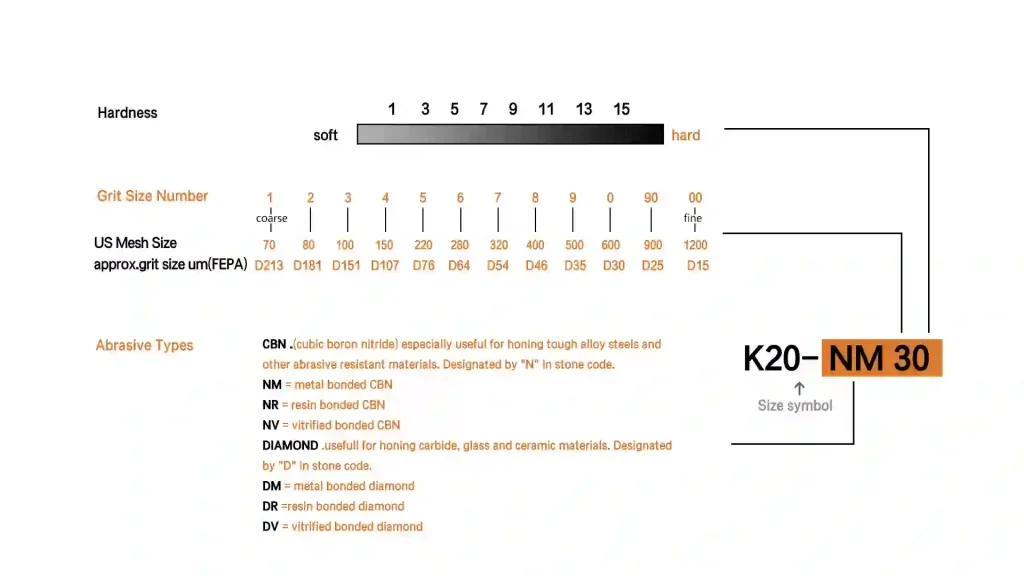
3.1 Abrasive Media for L‑Type Mandrel System Honing Stones
Superabrasives include two types: diamond and CBN. When machining hard and brittle materials or materials containing ferrous elements, these two abrasives complement each other. For more details, please refer to the table below.

3.2 Bond Systems for L‑Type Mandrel System Honing Stones
Common bond types for superabrasive stones include metal bonds and resin bonds.
- Metal bonds are typically used in the rough-honing stage. They offer long life, but require timely dressing during the process to expose fresh cutting edges and maintain consistent sharpness.
- Resin bonds are more often used for precision or finishing stages. Although they have a shorter life, they provide excellent sharpness and natural elasticity, resulting in superior surface finish on the workpiece. They are ideal for later-stage honing where higher quality and finer surface accuracy are required.
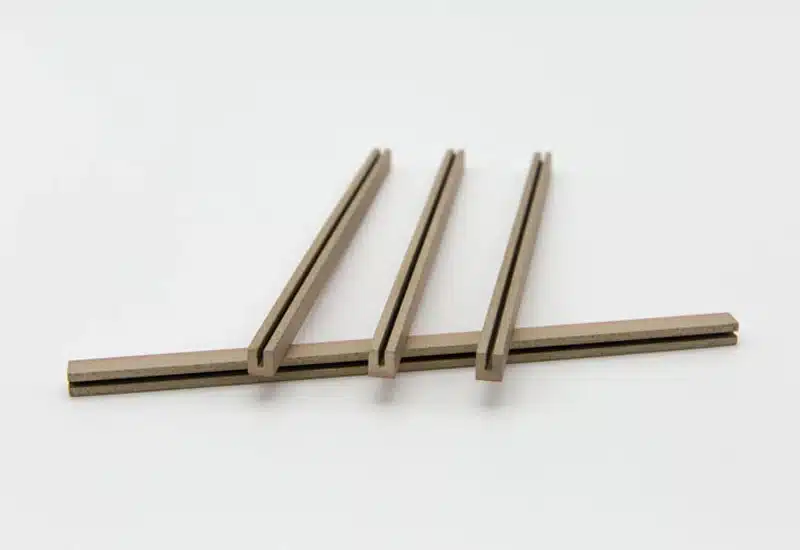

3.3 Binder Hardness Grades for L‑Type Mandrel System Honing Stones
Therefore, the bond hardness should be adjusted according to the specific material being honed in order to achieve the optimal balance of efficiency and durability.
The hardness of the bond directly affects the self-sharpening behavior of the honing stone.
A bond with good self-sharpening provides high cutting sharpness during machining, but the overall stone life will be shorter.
A bond with poor self-sharpening delivers lower cutting efficiency, but the stone life is longer.
3.4 Length Dimensions for L‑Type Mandrel System Honing Stones
This can be determined by referring to the markings on the existing honing stone. The key is to select a compatible honing mandrel based on bore diameter. Different mandrels call for specific honing‑stone dimensions, which follow common industry standards. Customers only need to supply the specifications of their current honing stone.
4. Regarding the four honing application scenarios:
Through-Hole Honing
Through-hole honing is used for bores that are completely open on both ends. During honing, the head enters from one side of the bore and exits fully from the other. This allows for excellent chip removal and cooling, uniform abrasive contact, and easier control of surface roughness.
The process is highly stable, offers high machining efficiency, and is the most widely used honing method. Typical applications include hydraulic cylinders, bearing housings, engine liners, and similar components.

Blind Hole Honing
Blind-hole honing is used for bores that are closed at one end. Since the honing head cannot pass through, precise feed control is required at the bottom of the bore. The bore bottom is prone to unmachined areas, so mandrels with guide shoes or controllable expandable heads are typically used.
The process demands strict machining parameters, with particular emphasis on stroke control and cooling. Blind-hole honing is commonly applied to components such as valve bodies, pump housings, and compressor cylinders.

Stepped Hole Honing
Stepped-hole honing is used for bores with different diameter segments along the axis (stepped or multi-diameter bores). During honing, the feed pressure and stroke must be carefully controlled for each segment. Each bore segment requires a matching mandrel size or segmented machining. High accuracy in positioning and concentricity is critical. This method is commonly applied to components such as hydraulic valve bodies, multi-chamber parts, and fuel injector seats.
Taper / Special Hole Honing
Taper or special-shape hole honing is used for non-standard geometries such as tapered bores, oval bores, polygonal bores, and complex contoured holes. This process requires adjustable or custom-designed mandrels, and often custom honing tools and guiding fixtures as well. Although the machining difficulty is high, it can achieve exceptional form accuracy and superior surface quality. This method is ideal for precision components such as hydraulic control valves, optical parts, and high-accuracy aerospace fittings.
Why Select Newdiamond for L‑Type Mandrel System Honing Stones ?
NewDiamond is a high-tech enterprise specializing in the research, development, and manufacturing of precision honing tools, with a strong focus on honing stones and honing mandrels. Equipped with advanced production processes, a complete inspection system, and an experienced technical team, the company is committed to providing customers with honing products that offer high precision, long service life, and excellent consistency.

NewDiamond provides honing stones and mandrels compatible with a wide range of honing machine systems. We also develop custom‑fit products for diverse equipment platforms according to customer‑supplied samples or drawings. For processing metals, ceramics, glass, crystals, semiconductors, sapphire, silicon carbide and other hard‑to‑machine brittle materials, NewDiamond delivers well‑matched abrasive and bond solutions (including diamond, CBN, aluminum oxide, silicon carbide, etc.) for rough honing, semi‑finishing and precision honing operations.
With superior product performance, stable supply capability, and fast technical support, NewDiamondtools has become a long-term partner for many precision manufacturing companies both domestically and abroad. Upholding the philosophy of “Quality First, Innovation Driven, Customer Oriented,” the company continuously enhances product quality and service levels, striving to become a global leader in advanced honing solutions.
Product specifications are for reference only. Performance may vary depending on workpiece material, machining setup and operating conditions. All trademarks and product names belong to their respective owners. We are not affiliated with or endorsed by any third-party brand or manufacturer.

Comments are closed.