


If you need honing stones with K‑type honing mandrel systems, you can find cost‑effective super‑abrasive solutions here.


NewDiamondtools Our company follows rigorous production workflows to deliver high‑quality honing stones to customers, supported by competitive pricing and shortened production lead‑times.
Honing stones for K‑type honing mandrel systems are mainly manufactured from super‑abrasive materials including diamond and CBN. They are intended for horizontal honing machines and perform precision internal bore finishing on components such as engine cylinders, compressors and other similar workpieces.

We supply super‑abrasive honing stones with K‑type, L‑type, B‑type, R‑type, Y‑type and P‑type honing mandrel systems, available in many grit sizes and hardness grades.
Abrasives and Applications for K‑Type Mandrel System Honing Stones
About the abrasives: this is a frequently discussed topic, but it’s still worth explaining here. The K-Series stone mainly uses superhard abrasives — CBN and diamon
- CBN abrasives are typically used for honing ferrous materials such as tool steel, high-speed steel, and stainless steel.
- Diamond abrasives, on the other hand, are more suitable for materials like hard alloys, cast iron, industrial ceramics, and optical glass.

If the markings of parameter on a honing stone are clear enough, we can extract plenty of product information from those alphanumeric codes, since the formulations and specifications they represent are standardized.
Meaning of parameters in the K-Series honing stones
When selecting honing stones for K‑type honing mandrel systems, it is important to understand the parameter markings on the stones. While we have extensive industry experience, we find it useful to explain these parameters to help customers better understand the honing stones they purchase.

For example, let’s take a look at this model: K12–NM15.
- Different mandrel series are used for honing holes of various sizes — for example, you might use a “K-Series” or a “P-Series” mandrel depending on the bore size and application.
- The characters“12” indicate the honing size range of the mandrel. For example: If the number is“6”, it fits a bore size range of “4.7–6.22 mm” . If the number is“12”, it fits a bore size range of “8.4–12.57 mm”.In other words, the number specifies the mandrel (and corresponding stone) size suitable for a particular bore diameter range.
- The character “N” represents the “type of abrasive used”.In this case, “N” stands for “CBN (Cubic Boron Nitride)” abrasive.This letter can also vary depending on the material being honed — for instance, if it’s “D”, it indicates that the stone uses “diamond abrasive” instead.
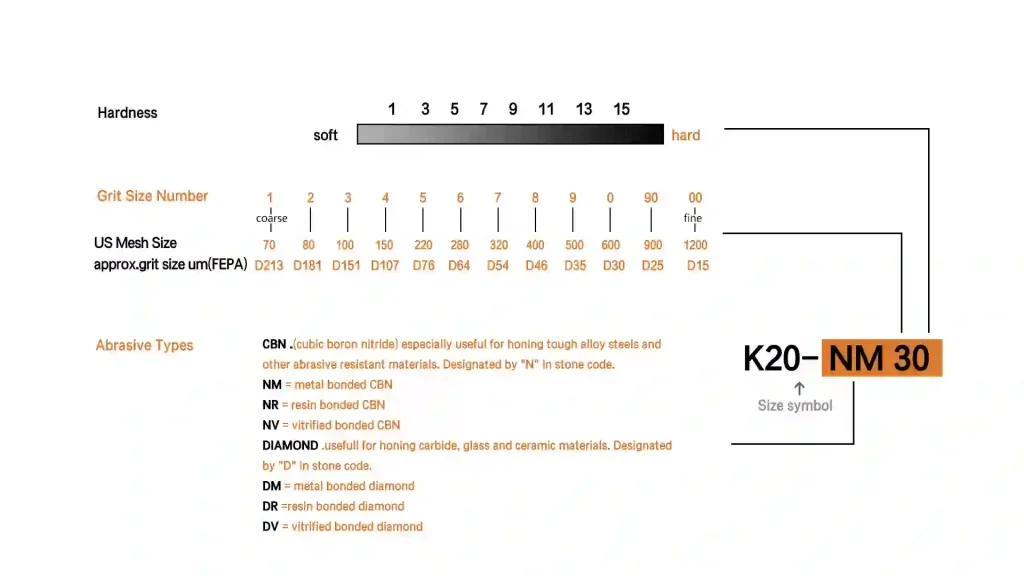
- The character “M” represents the “bond type”. For superabrasive materials, the two common bond types are “resin bond” and “metal bond”:M = Metal bond, which offers *longer tool life.R = Resin bond, which provides a smoother surface finish.
- The number “5” represents the “bond hardness”. With the abrasive grit size fixed, adjusting the bond hardness helps achieve a balance between cutting sharpness and tool life.Lower bond hardness means the bond is softer, which gives the stone sharper cutting action. However, if it’s too soft, the bond may not hold the diamond or CBN particles effectively, leading to abrasive loss and shortened tool life. Higher bond hardness makes the stone more rigid, but it cuts less efficiently — like a strong man trying to chop a tree with a blunt axe — wasting time and effort**.


For the last two parameters, a more detailed explanation can be found in the table below, which also includes information such as **material removal rate** and provides a clearer understanding of their effects.
| Code | NM75 | NM55 | NM50 | NM45 | NM65 | NM85 | NM95 | NM15 | NM05 | NM04 | NM005 |
|---|---|---|---|---|---|---|---|---|---|---|---|
| Grit Size | 80# | 100# | 120# | 140# | 180# | 240# | 280# | 300# | 400# | 500# | 800# |
| Abrasive Grit Size | D181 | D151 | D126 | D107 | D91 | D64 | D54 | D48 | D35 | D25 | D15 |
| Surface Finish | 2.0-1.6 | 1.6-1.4 | 1.6-1.4 | 1.4-1.3 | 1.3-1.0 | 1.0-0.8 | 0.8-0.7 | 0.8-0.6 | 0.6-0.4 | 0.4-0.2 | 0.2-0.1 |
| Stock Removal | 0.1-0.2 | 0.05-0.1 | 0.05-0.1 | 0.05-0.1 | 0.03-0.1 | 0.03-0.07 | 0.02-0.035 | 0.015-0.03 | 0.01-0.015 | 0.01-0.015 | 0.005-0.01 |
Installation Precautions for K-Type Honing Stones
Based on industry standard specifications, the installation of K-Type honing stones shall follow the key steps and precautions below:
Pre-installation preparation
- Inspect the K‑Type honing stone: Before installation, ensure the stone surface is free of protective films or contaminants to avoid compromising machining accuracy.
- Select a matching mandrel:K‑Type honing stones must be used with compatible horizontal honing machines, ensuring the stone type (e.g., K10, K12) matches the equipment.
- Clean the work environment: High cleanliness is essential for honing. Thoroughly clean the workpiece bore and mandrel to prevent abrasive particles or debris from embedding into the surface.

Installation steps
- Secure the K-Series honing stone: Attach the stone to the stone holder using adhesive, ensuring the holder can slide smoothly in the radial direction.
- Adjust spring pressure: Use the spring seat to regulate the spring force, making sure the taper inside the honing head evenly pushes the stone holder for consistent radial feed.
- Centering calibration: After installation, check the alignment between the honing spindle and the workpiece bore to prevent out-of-roundness caused by misalignment.

Precautions
- Prevent excessive honing heat: Control the stock removal, spindle speed, and pressure, and select the appropriate stone grit (e.g., NM55, NM05) along with suitable coolant to avoid thermal deformation affecting dimensions.
- Perform regular tool maintenance: Check the automatic measuring system, air supply stability, and honing fluid cleanliness to ensure the process system remains stable.
K‑Type honing stones can be customized according to customer‑supplied samples, with defined material, dimension, grit size, hardness and other parameters. Users may also select the proper grit based on the **honing machine, workpiece, workpiece material and hardness, stock removal, surface finish, and crosshatch requirements**.

For further details about our honing‑stone solutions, please refer to the link below.
Product specifications are for reference only. Performance may vary depending on workpiece material, machining setup and operating conditions. All trademarks and product names belong to their respective owners. We are not affiliated with or endorsed by any third-party brand or manufacturer.

Comments are closed.